Common Problems with Student Houses in Lancaster – and How to Handle Them
What if the biggest student-house headache isn’t a leaky tap or patchy broadband, but not knowing who’s responsible for sorting it? Common problems with student houses in Lancaster can include repairs, damp or mould, household bills, internet hiccups and disagreements over noise or shared spaces. They’re possible issues, not inevitable features of every property.
It’s understandable to want clear answers before you sign, especially when you’re sharing a home with friends and relying on it for studying as well as downtime. Knowing how to report maintenance issues, what the rent includes and how housemates will share responsibilities can make moving in more manageable.
This guide explains what to look for during a viewing, what to clarify before signing and how to raise issues early. It also covers the practical support to look for, from a clear property contact to straightforward arrangements for bills and broadband. Unipad owns and maintains its Lancaster homes directly, providing professional support for students looking for a more straightforward way to manage shared living.
Key Takeaways
- Common problems with student houses in Lancaster can include maintenance faults, damp, bills, broadband and housemate disagreements, but none is inevitable in every home.
- Separate property faults from shared-house misunderstandings so you know whether to report an issue or discuss it with housemates.
- Compare homes by how repairs are reported, what emergency support is available, which bills are included and who your property contact is.
- Use a pre-signing and move-in checklist to record questions, check the property and keep written details of issues you report.
- Direct ownership and maintenance, clear support arrangements and stated inclusions can help make student living more manageable.
Common problems with student houses in Lancaster: what to expect
Leaks, heating faults, damp, confusing bills and unreliable broadband can all disrupt student life, but they’re possible issues, not inevitable features of every shared house. Common problems with student houses in Lancaster generally fall into two groups: property faults that need reporting, and day-to-day arrangements that housemates need to manage together.
Condition matters, but so do the tenancy arrangements and the process for getting help when something goes wrong. A small fault may be straightforward to report if you know who to contact. If the contact route is unclear, the issue can be harder to track. In student-dense areas, shared living brings its own routines and considerations, as the general overview of a student quarter illustrates. For students at Lancaster University or the University of Cumbria, understanding how a particular home is maintained can make moving into shared accommodation more predictable.
Which maintenance issues should students look out for?
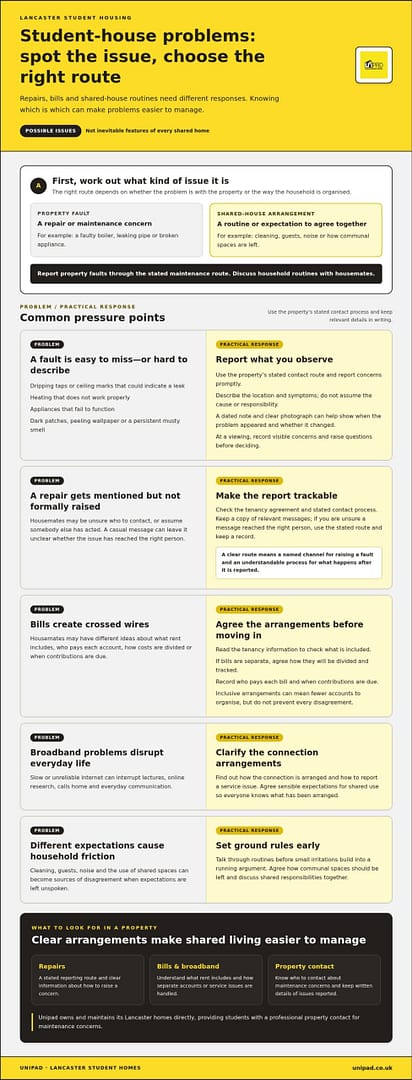
Look for dripping taps, ceiling marks that could indicate a leak, heating that doesn’t work properly, appliances that fail to function and signs of damp such as dark patches, peeling wallpaper or a persistent musty smell. If you spot a concern, report it promptly through the property’s stated contact route. Describe what you’ve noticed without assuming you know the cause or who is responsible.
A dated note and a clear photograph can help show when a problem appeared and whether it changed. If you’re viewing before signing, record visible concerns and raise questions about them before deciding. During the tenancy, follow the stated reporting process and keep copies of relevant messages. This creates a clearer record without turning an initial observation into a conclusion about the fault.
Why can shared bills and broadband cause friction?
Household costs can lead to disagreements when everyone has a different understanding of what’s included, who pays each account or when contributions are due. Before moving in, read the tenancy information and agree how separate bills will be divided and tracked. Inclusive arrangements can reduce the number of accounts housemates need to organise, although they won’t prevent every disagreement about shared living.
Broadband matters too. Slow or unreliable internet can interrupt lectures, online research, calls home and everyday communication. Clarify the connection arrangements and how to report a service issue, then agree sensible expectations about shared use. Clear information at the outset can prevent the familiar “I thought you were sorting that” misunderstanding.
Why student-house problems happen: repairs, bills and shared responsibilities
Not every household issue has the same cause. A faulty boiler, leaking pipe or broken appliance is a property concern; disagreements about cleaning, guests or noise are usually about how people share a home. The distinction matters because a fault should go through the property’s repair-reporting process, while household routines call for a conversation between housemates.
Confusion can set in when nobody knows who to contact, a fault is mentioned casually but never formally reported, or housemates assume someone else has acted. Different expectations can also cause crossed wires: one person may think a message has been sent, while another believes the issue is still being discussed. Keeping a record and using a known reporting route helps avoid that confusion.
Who should deal with a repair or maintenance concern?
Start with the tenancy agreement and the property’s stated contact process. These should explain the appropriate reporting channel. The UK government’s guide to private renting is also a useful reference for wider renting information. Report a concern promptly, describe its location and symptoms, and include relevant images if they help. Avoid guessing at the cause or deciding who is responsible before the issue has been assessed.
A clear repair-reporting route means having a named channel for raising a fault and an understandable process for what happens after it’s reported. If you’re unsure whether a message reached the right person, use the stated route and keep a copy. That makes it easier to tell the difference between an unresolved repair and an issue that hasn’t yet been formally raised.
How can housemates prevent avoidable disputes?
Agree everyday ground rules early, before small irritations turn into a running argument. Talk through cleaning, guests, noise and how communal spaces should be left. If household accounts are managed separately, record who pays each bill, how contributions are divided and when payments are due. If utilities and broadband are included in the rent, that can simplify account administration, but it won’t settle every question about fair use or shared responsibilities.
A clear property contact can help keep the two kinds of problem separate: report faults through the maintenance route and discuss household routines together. Unipad owns and maintains its Lancaster residences directly, giving students a professional property contact for maintenance concerns. If that kind of support matters to your choice, explore student houses and apartments in Lancaster. Clear arrangements can stop common problems with student houses in Lancaster becoming harder to untangle.
How to compare Lancaster student houses by maintenance and support
House problems aren’t automatically unavoidable. A clear reporting process, written information and a home that suits your group can make everyday issues more manageable. Compare the practical arrangements, not just the room photographs: support can shape your experience as much as the property itself.
What should students compare before choosing a house?
Use the same questions for each viewing or property listing, then note what’s answered clearly and what needs clarification. Look for specific written details rather than relying on a quick verbal assurance. Also consider whether the number of occupants, shared facilities and communal space suit your group’s routines.
| What to compare | What to look for |
|---|---|
| Repair reporting | A named contact or channel, clear instructions for reporting a fault, and information on how updates are shared. |
| Emergency support | Written guidance distinguishing urgent emergencies from routine maintenance, including which contact route applies to each. |
| Bills | A clear breakdown of what the rent includes and which household accounts, if any, tenants arrange and manage separately. |
| Broadband | Whether internet is included, how connection issues are reported and what service information is provided. |
| Property contact | Who students should approach about the home, and whether replies explain next steps rather than leaving questions open. |
| Group fit | Whether the bedrooms, shared spaces and facilities work for the number of people who will live there. |
What does reliable property support look like?
Reliable support starts with a clear point of contact and a defined process for routine requests. Notice how enquiries are handled: are the answers easy to understand, are practical next steps explained, and is it clear how to follow up? This helps you assess communication before you commit, without assuming every repair will be resolved instantly.
Routine maintenance and emergency support need different reporting routes. The property information should explain which route to use for each, so residents aren’t left guessing when an issue arises. Unipad directly owns and maintains its Lancaster residences, with maintenance support and 24/7 emergency support as part of its service. For more detail on group living, read this guide to luxury student houses in Lancaster.
All-inclusive utilities and broadband can simplify household administration by reducing the need to organise separate accounts. They don’t necessarily mean unlimited use, so read the written terms on inclusions and any usage arrangements. Comparing these details can help you choose a home where common problems with student houses in Lancaster are easier to report and manage.
A practical Lancaster student-house checklist before and after moving in
A little preparation can turn uncertainty into a clear plan. Use this checklist to understand the arrangements before you commit, record the home’s condition when you arrive and make sure concerns reach the right person. These steps can help keep common problems with student houses in Lancaster manageable.
- Before signing, read the tenancy information. Note who to contact about routine maintenance and emergencies, how to report an issue and how updates are shared. Keep a copy of the agreement and related messages where everyone in the household can find them.
- Clarify what the rent includes. Look for written details about utilities, broadband and any other stated services. If accounts are managed separately, agree how payments and responsibilities will be organised between housemates.
- Check the practical fit. Make sure the number of bedrooms, shared facilities and communal spaces work for your group. Read any property-specific instructions, including how to use appliances or manage shared areas.
- On arrival, record visible condition concerns. Check rooms and communal spaces for marks, damp, leaks, damaged fittings or appliances that don’t appear to work. Take dated photographs where useful, and follow any move-in recording process provided for the property.
- Raise issues early through the stated route. Note when a problem appeared, where it is and how it affects use of the space. Send a concise report with relevant images, then keep a copy of the message and any response. Don’t rely on a passing conversation as the only record.
- Prioritise safety if there’s immediate danger. Move away from danger and contact the appropriate emergency services; in the UK, call 999 or 112 for an immediate emergency. Once safe, use the property’s emergency contact process as well, where appropriate.
Keep useful documents and communications together, such as in a shared folder or another place each tenant can access. Clear records help the household see what was agreed, what has been reported and what still needs attention. For a broader view of housing options, explore this Lancaster accommodation guide.
Looking for a Lancaster home with direct maintenance support and clear property arrangements? Explore Unipad student accommodation.
A more supported student-house experience in Lancaster with Unipad
Support arrangements can influence how manageable a home feels when something needs attention. Unipad owns and maintains its Lancaster residences directly, with ongoing property maintenance and 24/7 emergency support. Residents have a clear route to a service focused on student accommodation, while the time and steps involved in resolving an issue depend on what needs attention.
How can direct management help with common house concerns?
With a direct property contact, students have a point of reference for raising maintenance concerns and getting updates about next steps. This can reduce uncertainty about where to report a fault, especially if it affects a shared area or needs follow-up. It won’t prevent every maintenance problem, but clear communication makes it easier to keep track of what has been reported.
All-inclusive arrangements can also simplify household administration. Unipad’s stated inclusions cover electricity, water, heating and high-speed broadband, with details applying to each property. Grouping these services can mean fewer separate accounts for housemates to organise, though tenants still need to understand the rental terms and agree expectations around shared spaces and household routines. For a wider overview, read the student accommodation guide for Lancaster.
How can students explore Unipad accommodation?
Different households need different setups. Unipad offers private studios, student apartments and shared houses, with options for individuals as well as groups. Its residences are centrally located in Lancaster, with transport links to Lancaster University and the University of Cumbria, supporting students who want access to both the city and their campus.
As you compare homes, look beyond the room itself. Consider the reporting process, support arrangements, written inclusions and whether the layout fits your household. These details can help you decide which accommodation suits your studies and day-to-day life. Explore Unipad student accommodation in Lancaster and find a home that suits your plans.
Choose your Lancaster student home with confidence
Common problems with student houses in Lancaster aren’t inevitable. Before signing, clarify how to report repairs, what the rent includes and who to contact. Once you move in, keep useful records and raise concerns through the stated route. Clear expectations between housemates can also stop everyday disagreements from growing.
Support matters too. Unipad has focused on student accommodation in Lancaster since 2008 and directly owns and maintains its residences. Its service includes ongoing maintenance and 24/7 emergency support, giving students a clear property contact when issues arise.
If you’re weighing up your next move, explore the homes and consider which layout and support arrangements suit your household. Explore Unipad student accommodation in Lancaster and take the next step towards a more supported student living experience.
Frequently Asked Questions
What are the most common problems with student houses in Lancaster?
Common concerns include maintenance faults, damp or mould, unclear household bills, broadband interruptions and disagreements about noise, cleaning or shared spaces. These are possibilities, not inevitable features of every student home. The experience can depend on the property’s condition, how housemates organise daily routines and how straightforward it is to report a fault. Before signing, look for clear written information about bills, maintenance contacts and support arrangements.
Is damp a common problem in student houses?
Damp can occur in student houses, but it doesn’t affect every property. During a viewing, look for dark patches, peeling wallpaper, persistent condensation or a musty smell. If you notice signs after moving in, take dated photographs and report them through the property’s stated contact route. Describe where the issue is and what you’ve observed rather than assuming the cause. Prompt, clear reporting helps ensure the concern is recorded.
What should I do if something needs repairing in my student house?
Report the fault promptly using the contact route described in your tenancy information or property instructions. Include its location, what’s happening and how it affects use of the space; attach a photograph if it helps explain the problem. Keep a copy of your message and any reply. Don’t assume a casual mention to a housemate counts as a formal report, and avoid guessing at the cause or responsibility.
Can bills cause disagreements in a shared student house?
Yes. Confusion can arise if housemates aren’t clear about which accounts are included, who pays separate bills or how contributions are divided. Before moving in, read the rental information and write down agreed payment arrangements, including due dates and who will manage each account. Inclusive bills can reduce the administration of separate household accounts, but housemates may still need to agree expectations around shared use and responsibilities.
Does all-inclusive student accommodation include broadband and heating?
It can, but inclusions vary by property, so read the written rental details before signing. Unipad’s all-inclusive service covers electricity, water, heating and high-speed broadband, with details applying to each property. Bundling these services can make household administration more straightforward, as tenants may not need to organise each account separately. Read the stated terms for what’s covered and any usage arrangements rather than assuming “all-inclusive” means unlimited use.
How can students avoid problems when moving into a Lancaster student house?
Before signing, clarify the maintenance contact, emergency process, included bills and broadband, and any property-specific instructions. On arrival, check rooms and shared areas, record visible condition concerns with dated photographs and follow the move-in reporting process. Agree practical expectations with housemates about cleaning, guests and communal spaces. If an issue appears later, report it through the stated route and keep a copy of your communication.
Is a professionally managed student house better than a privately managed one?
It depends on what support and arrangements matter to you. A professionally managed home may offer a defined maintenance process and a clear property contact; compare these details with the written arrangements for any home you’re considering. Look for clarity on routine repairs, urgent issues, bills and how updates are shared. Unipad directly owns and maintains its Lancaster residences, offering students a professional point of contact for property concerns.
Who should I contact about an urgent issue in a student house?
Use the emergency contact route in your tenancy information or property instructions for urgent property issues, and follow the guidance provided there. If someone is in immediate danger, move to safety and contact the appropriate emergency services. For a non-emergency fault, use the ordinary maintenance reporting process instead. Knowing the difference between these routes before an issue arises can help you act promptly and confidently.