Lancaster Attractions: The Ultimate 2026 Student Guide to the City
Here’s a truth that catches most new students off guard: Lancaster is one of the most genuinely exciting student cities in the north of England, and the majority of people studying here barely scratch the surface of it. If you’ve been wondering what the lancaster attractions scene actually looks like beyond the campus bubble, you’re asking exactly the right question.
It’s completely understandable. Settling into university life is overwhelming, and the city centre can feel like unfamiliar territory when you don’t know where to start. The worry that everything worth doing will cost a fortune doesn’t help either.
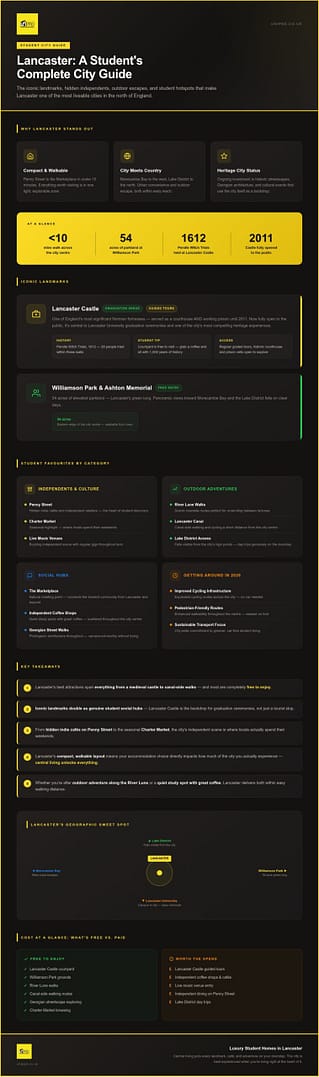
But here’s the thing: Lancaster is a pocket-sized powerhouse. Medieval castle walls sit a short walk from independent coffee shops, buzzing live music venues, and some of the most photogenic streets you’ll find anywhere in Lancashire. This guide cuts through the noise and gives you a curated, honest look at the historic landmarks, hidden independent gems, and student-friendly hotspots that make this city genuinely worth exploring. Whether you want the perfect spot for a Saturday afternoon with friends, a backdrop worthy of your camera roll, or simply the confidence to feel like a local rather than a visitor, you’ll find it all right here.
Key Takeaways
- Lancaster’s best lancaster attractions span everything from a medieval castle to independent canal-side walks — and most of them are completely free to enjoy.
- You’ll discover which iconic landmarks double as genuine student social hubs, not just tourist photo stops, and how to make the most of them throughout the academic year.
- From hidden indie cafés on Penny Street to seasonal highlights like the Charter Market, this guide reveals where locals actually spend their weekends.
- The city’s compact, walkable layout means your accommodation choice has a direct impact on how much of Lancaster you actually experience — central living unlocks everything.
- Whether you’re after outdoor adventure along the River Lune or a quiet study spot with great coffee, you’ll leave knowing exactly where to go and how to get there.
Exploring Lancaster: More Than Just a University City
Lancaster doesn’t announce itself. It doesn’t need to. This compact, walkable city has quietly built one of the most layered and genuinely liveable urban environments in the north of England, and once you start exploring it properly, the appeal becomes obvious fast. Georgian terraces line streets that curve uphill toward a medieval castle. Independent coffee shops sit a few minutes’ walk from a working canal. And on a clear day, the fells of the Lake District are visible from the city’s higher vantage points. That’s not a postcard. That’s just a Tuesday.
Geographically, Lancaster occupies a rare sweet spot. It sits between Morecambe Bay to the west and the southern edge of the Lake District to the north, meaning the city genuinely delivers on the “city-meets-country” promise that so many places claim but rarely fulfil. Students here don’t have to choose between urban convenience and outdoor escape. Both are within easy reach, and that balance shapes the character of the place in a way that’s hard to replicate elsewhere.
Why Students Love the City Centre
The walk from Penny Street to the Marketplace takes under ten minutes, but it passes through the heart of everything that makes Lancaster worth exploring. Culture, commerce, independent dining, and historic architecture all sit within the same compact zone. For students used to the quieter, campus-focused atmosphere at Lancaster University, the city centre offers a genuine contrast: buzzing street life, a strong independent retail scene, and a social energy that feels distinctly different from the bubble of university life. It’s where Lancaster students and those studying further north in Cumbria both gravitate at weekends, making it a natural meeting point for the wider student community.
Lancaster in 2026: What to Expect
The city’s independent scene continues to evolve, with new food and drink concepts regularly emerging alongside established favourites. Lancaster has also made a visible commitment to sustainable transport, with improved cycling infrastructure and pedestrian-friendly routes making it easier than ever to get around without a car. Underpinning all of this is the city’s recognised Heritage City status, which brings ongoing investment in the preservation and promotion of its historic built environment. For students, that translates directly into a richer set of lancaster attractions to explore, from beautifully maintained Georgian streetscapes to cultural events that use the city’s architecture as their backdrop.
Living centrally matters here more than in most student cities. When the city’s best experiences are genuinely on your doorstep, you actually use them.
The Iconic Landmarks: Heritage Meets Student Life
Lancaster’s most recognisable landmarks aren’t just backdrops for tourist photographs. They’re genuinely woven into student life here, showing up at graduation ceremonies, weekend walks, and impromptu revision sessions in equal measure. Understanding how to actually use these spaces, rather than simply admire them, is what separates locals from visitors.
Lancaster Castle: A Living History
Few buildings in the north of England carry as much weight as Lancaster Castle. For centuries it served simultaneously as a courthouse and a working prison, a dual function that only ended in 2011 when the prison finally closed. That transition unlocked something remarkable: one of England’s most significant Norman fortresses became fully accessible to the public, and the result is one of the most compelling lancaster attractions you’ll find anywhere in the region.
Guided tours run regularly and dig into the castle’s darker chapters, most notably its central role in the infamous Pendle Witch Trials of 1612, when twenty people were tried within these very walls. It’s genuinely gripping history, and the kind of storytelling that no textbook quite captures. Beyond the tours, the castle’s courtyard is worth visiting on its own terms: grab a coffee, find a quiet bench, and sit surrounded by medieval stonework that’s been standing for nearly a thousand years. It costs nothing to appreciate that.
For Lancaster University students specifically, the castle holds additional significance as the backdrop for graduation ceremonies, giving it a personal resonance that goes well beyond sightseeing.
Williamson Park and the Ashton Memorial
Covering 54 acres of elevated parkland on the eastern edge of the city centre, Williamson Park functions as Lancaster’s green lung. On a warm afternoon, you’ll find students spread across the grass with laptops and lecture notes, making it one of the most productive outdoor revision spots you’ll encounter anywhere. The park’s elevated position means the views stretch west across Morecambe Bay on clear days, and northward toward the fells, which is a combination that genuinely rewards the uphill walk.
Dominating the skyline from the park’s highest point is the Ashton Memorial, a baroque folly commissioned in the early twentieth century and now one of Lancaster’s most photographed structures. The memorial terrace offers what is arguably the finest sunset vantage point in the city; arrive with friends around golden hour and you’ll understand why it earns its reputation. On days when the weather turns, the park’s Butterfly House offers a quirky, tropical alternative: a warm, humid escape filled with exotic species that feels entirely incongruous with a Lancashire afternoon, and is all the better for it.
The Priory Church, sitting just below the castle on the hill, completes this cluster of historic lancaster attractions. Dating back to the twelfth century, it’s a genuinely peaceful space for quiet reflection, and its ancient interior offers a striking contrast to the bustle of the streets below.
Living close to all of this matters more than most students initially realise. When Williamson Park and the castle are a short walk from your front door rather than a bus journey away, you actually visit them. Students in centrally located accommodation with Unipad’s luxury student properties find that Lancaster’s landmark spaces become a natural extension of daily life rather than an occasional day trip.
Student Favourites: Independent Culture and Quirky Cafes
Lancaster’s independent scene is one of its best-kept secrets, and it’s the kind of thing you only fully discover when you’re actually living here rather than passing through. Day-tripper guides give you a generic list of shops and restaurants. What they don’t tell you is which spots have become genuine student institutions, the places where you’ll spend a disproportionate amount of your academic year without ever regretting it.
Independent Shopping and Markets
The Charter Market is the beating heart of Lancaster’s independent retail culture. Running every Wednesday and Saturday in the historic Marketplace, it draws a loyal mix of students, locals, and food enthusiasts who know exactly where to find the best regional produce, vintage clothing, and handmade goods in the city. Saturday mornings are busiest and most rewarding: arrive early for the best vintage finds, pick up fresh bread and local cheese, and you’ve got a weekend sorted for next to nothing.
For something more curated, the Assembly Rooms Emporium on King Street is worth an afternoon of your time. It’s the kind of space that rewards browsing: independent traders selling alternative fashion, unusual gifts, and handcrafted items that you genuinely won’t find anywhere else. Shopping here isn’t just good for your wardrobe; it’s a direct investment in the independent businesses that give Lancaster its distinct character.
The Best Spots for a Study Break
Lancaster punches well above its weight for independent cafes, and several of them have quietly become student staples. The best ones share a few qualities: genuine welcome for laptop workers, reliable Wi-Fi, and coffee that doesn’t taste like it was made as an afterthought. Penny Street and the surrounding lanes are your starting point. You’ll find cosy, unhurried atmospheres that are a world away from the corporate chain experience, and the kind of background noise level that’s actually conducive to getting work done.
Post-deadline brunches deserve a proper venue. Lancaster’s independent cafes deliver on this front with seasonal menus and locally sourced ingredients that make the occasion feel genuinely celebratory. It’s one of those small pleasures that students living centrally access instinctively; when the city’s best spots are on your doorstep, they become part of your routine rather than a special trip. Students who want a private, distraction-free alternative for deep work sessions can explore the luxury student studios in Lancaster that Unipad offers, where high-spec living spaces double as genuinely productive environments.
Beyond cafes, Lancaster’s arts venues round out the independent culture picture beautifully. The Dukes theatre offers affordable tickets and a consistently strong programme of productions, many of which are specifically priced with students in mind. The Grand Theatre, one of the oldest working theatres in the country, hosts everything from student-led performances to professional touring companies. These aren’t just lancaster attractions in the tourist sense; they’re the cultural infrastructure that makes living here feel genuinely rich rather than merely convenient.
The city’s craft brewery scene adds another dimension entirely. Several of Lancaster’s historic pubs now showcase locally brewed ales from independent breweries, giving the city a drinks culture that feels rooted in place rather than imported from a corporate playbook. It’s the kind of thing you appreciate more with each passing term.
Outdoor Adventures and Seasonal Highlights
Lancaster’s outdoor offer is quietly extraordinary. The city sits at the convergence of two distinct waterway corridors, flanked by open countryside, and within striking distance of some of the most celebrated landscapes in England. For students who’ve spent the week in lectures and libraries, this is where the city genuinely earns its keep.
Walking and Cycling Routes
The Lancaster Canal is the obvious starting point. Flat, traffic-free, and lined with narrowboats and open countryside, it’s ideal for a morning run or a leisurely cycle. A particularly rewarding route takes you south from the city centre toward the Lune Aqueduct, one of the most impressive pieces of Georgian engineering you’ll find anywhere in Lancashire. The walk from the Marketplace to the Aqueduct takes roughly forty minutes at a comfortable pace: head down Meeting House Lane, pick up the towpath near Aldcliffe Road, and follow the canal until the Aqueduct appears overhead. It’s a genuinely striking arrival. Beneath it, the River Lune curves through a wide, wooded valley that feels miles removed from city life.
Cycling to Morecambe via the Greenway takes under thirty minutes on two wheels and delivers coastal views that are difficult to believe are this close to a city centre. The route is largely off-road, well-maintained, and accessible to anyone with a basic bike. It’s the kind of spontaneous half-day trip that becomes a regular fixture once you’ve done it once.
Beyond the main routes, Lancaster is threaded with quieter green lanes and field paths that reward exploration. Head east from the city and you’ll quickly find yourself in open farmland with the Bowland fells rising ahead of you. These hidden routes are among the lesser-known lancaster attractions that most students never discover.
Must-Attend Events in the 2026 Calendar
Light Up Lancaster is the event that defines the autumn term. Held annually in November, it transforms the city centre into an open-air gallery after dark, with large-scale light installations projected onto historic buildings, fire performances, and a fireworks finale that draws crowds from across the region. It’s not just a tourist spectacle; it’s a genuine community event, and experiencing it with a group of friends from a central location is one of those university memories that sticks. Exact dates for the 2026 edition should be confirmed via Lancaster City Council’s official event listings as the season approaches.
The Lancaster Music Festival, typically held in October, takes over dozens of city-centre venues in a single weekend. Pubs, theatres, and independent spaces all host live acts simultaneously, making it a brilliant, low-cost way to discover the city’s music scene in one concentrated burst.
As winter arrives, Dalton Square hosts a seasonal ice rink and Christmas market that transforms one of Lancaster’s most elegant Georgian spaces into something genuinely festive. It’s the kind of lancaster attractions calendar that makes the colder months feel worthwhile rather than something to endure.
Day trips add another dimension entirely. The Lake District is under an hour away by train, and the Forest of Bowland, an Area of Outstanding Natural Beauty, is accessible by bike or bus from the city centre. Lancaster functions brilliantly as a base for both.
Students who live centrally access all of this without planning. If you want a home that puts the canal, the city, and the countryside within easy reach, explore Unipad’s centrally located student properties in Lancaster and see what’s genuinely on your doorstep.
Living Amongst the Action: Premium Student Bases
There’s a version of your Lancaster experience where the castle, the canal, and the city’s best independent cafés are a ten-minute walk away. And there’s another version where they’re a bus journey and a scheduling decision. The difference between those two versions isn’t luck. It’s where you choose to live.
This is the gap that no generic student accommodation guide addresses honestly. You can read every list of lancaster attractions in existence, but if your front door is miles from the action, the city’s best experiences stay theoretical. Proximity changes behaviour. When Williamson Park is genuinely on your doorstep, you actually go. When the Charter Market is a short walk away on a Saturday morning, you become a regular rather than an occasional visitor.
Centrally Located Luxury
Unipad’s properties are designed with exactly this in mind. Centrally located near Lancaster’s key transport links, they put campus, the city centre, and the wider region within easy reach, whether you’re heading to a lecture, catching a train to the Lake District, or cycling the Greenway to Morecambe on a free afternoon. The properties themselves are built for modern student life: high-spec interiors, fast connectivity, and the kind of thoughtfully designed living spaces that make coming home feel like a genuine reward rather than an afterthought. For a full breakdown of what premium student living looks like in practice, the Ultimate Guide to Luxury Student Living in 2026 covers everything worth knowing.
This matters beyond comfort. Your accommodation is where you decompress, focus, and recharge between everything Lancaster throws at you. A well-designed, well-managed space directly supports your academic performance and your wellbeing. That’s not a lifestyle upgrade. That’s a practical investment.
Secure Your Spot for 2026
The best central properties go early, and that’s not a sales line; it’s simply how Lancaster’s student housing market works. Booking ahead means you get to choose your location rather than settle for what’s left. It also means you benefit from Unipad’s direct, professional management model, where the people responsible for your property are the people who own it. No third-party middlemen. No chasing contractors.
Groups looking to share should explore Luxury Student Houses in Lancaster and book a group viewing sooner rather than later. The right house, in the right location, shared with the right people, is one of the best decisions you’ll make before your first term begins. Don’t leave it to chance.
Lancaster’s lancaster attractions are genuinely world-class for a city of its size. Make sure you’re actually positioned to enjoy them.
Your Lancaster Adventure Starts at Your Front Door
Lancaster genuinely delivers on every front. A medieval castle, independent cafés, canal-side walks, seasonal festivals, and some of the most accessible countryside in the north of England; these lancaster attractions aren’t just worth visiting once. They’re worth living amongst every day of your degree.
The key takeaway is simple: proximity is everything. The students who get the most from this city are the ones who can step outside and into it without a second thought. That’s not a coincidence. It’s a direct result of where they chose to live.
Unipad’s award-winning luxury student properties are centrally located, professionally managed by direct owners, and designed to put Lancaster’s best experiences within easy reach from day one. No middlemen, no compromises, no settling for less than you deserve.
Your Lancaster experience is waiting. Explore our luxury student properties in the heart of Lancaster and secure your spot before the best options go. You’ll thank yourself before the first term is out.
Frequently Asked Questions About Lancaster Attractions
What are the top-rated free attractions in Lancaster for students?
Lancaster delivers an impressive range of free experiences. The canal towpath walks, the Priory Church, the Marketplace, and the grounds of Williamson Park all cost nothing to enjoy. Wandering the Georgian streets around Castle Hill is genuinely rewarding on its own terms, and the Charter Market on Wednesdays and Saturdays requires no entry fee whatsoever. You can fill an entire weekend without spending a penny on admission.
Is Lancaster Castle free to enter for residents?
The castle’s exterior and courtyard are free to explore, but the guided interior tours carry an admission charge. These tours are well worth the cost given the depth of history covered, including the Pendle Witch Trials connection. Concession pricing is typically available for students, so always bring your student ID. Check Lancaster Castle’s official website for current tour schedules and up-to-date pricing before you visit.
Where are the best spots in Lancaster for a student-friendly night out?
Lancaster’s city centre packs a strong night-out offer into a compact, walkable area. The independent pub scene around Sun Street and Penny Street is particularly good, with several venues showcasing locally brewed ales from regional craft breweries. The Dukes theatre and Grand Theatre both host evening events at student-friendly prices. Because everything sits within easy walking distance, getting between venues is straightforward and safe.
How far is Williamson Park from the city centre?
Williamson Park is roughly a fifteen to twenty minute walk from the Marketplace, heading east uphill through the residential streets. It’s a manageable distance on foot, and the elevation gain is worth it for the views alone. Cyclists can reach the park gates even faster. Students living centrally find it genuinely easy to treat the park as a regular destination rather than an occasional trip.
What are the best day trips from Lancaster by train?
Lancaster’s rail connections are one of its most underappreciated assets. The Lake District is accessible from Oxenholme in under an hour, making spontaneous hiking days entirely realistic. Morecambe is a short hop along the coast line and worth a visit for its Art Deco architecture and bay views. Manchester and Leeds are both reachable in under ninety minutes, and Edinburgh is a comfortable two-hour journey north. Lancaster functions brilliantly as a base for the wider region.
When is the Light Up Lancaster festival taking place in 2026?
Light Up Lancaster traditionally takes place in November, but exact dates for the 2026 edition haven’t been officially confirmed at the time of writing. Lancaster City Council’s official events listings and the festival’s own website are the most reliable sources for confirmed dates as the season approaches. It’s worth bookmarking both early in the autumn term so you don’t miss what is genuinely one of the best lancaster attractions events of the year.
Are there any good shopping centres in Lancaster city centre?
Lancaster doesn’t follow the large shopping centre model that dominates many northern cities, and that’s genuinely part of its charm. The St Nicholas Arcades centre provides a convenient base for high street brands in the heart of the city. The real strength, though, lies in the independent retail scene: the Assembly Rooms Emporium, the Charter Market, and the independent shops lining Penny Street and Market Street offer a far more distinctive and rewarding shopping experience than any generic retail complex could.
Where can I find the best views of the Lake District from Lancaster?
The Ashton Memorial terrace in Williamson Park is the standout vantage point, offering clear northward views toward the fells on good days. Castle Hill also provides elevated sightlines across the city and beyond. For the most dramatic perspective, the higher ground east of the city centre rewards those willing to walk a little further out. Clear winter days, when the air is sharp and the fells are snow-capped, produce views that make the uphill effort feel entirely worthwhile.